
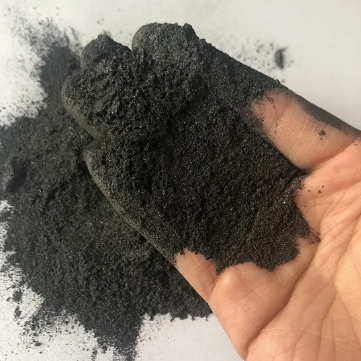
With the rapid development of the world’s industry, graphite powder has been regarded as one of the important industrial mineral raw materials both at home and abroad. Especially in recent years, with the advancement of science and technology, graphite has played a significant role in various industries.
In industry, graphite ores are classified into two major categories: crystalline graphite ores and stable crystalline graphite ores. Crystalline graphite ores can be further classified into two types: flaky and dense.
The graphite ores in China are mainly of the flaky crystalline type, followed by the cryptocrystalline type. Dense crystalline graphite is only found in a few deposits such as Tokbula in Xinjiang and has little industrial value.
Industrial graphite retains the original chemical properties of flake graphite, namely acid resistance, corrosion resistance and physical properties, as well as resistance to high and low temperatures. Its compressive strength is greater than 800kg/ cm ², and it is resistant to oxidation. It loses 1% of its weight in 450℃ air and has a rebound rate of 15-50%. It also has a very strong self-lubricating performance of graphite powder. Therefore, graphite has been widely applied in metallurgy, chemical engineering, petrochemicals, high-energy physics, aerospace, electronics and other fields.
Taking advantage of the properties of graphite, people have ingeniously produced various types of products according to the needs of engineering, such as high-purity graphite, flexible graphite, composite graphite, and so on. To enhance its performance, graphite is combined with fibers, graphite metal wires, metal meshes and metalworking plates to form graphite powder composite graphite, which greatly increases its strength and elasticity.
Composite graphite is mainly cold-pressed or hot-bonded with resins, synthetic rubbers and plastics. There are also liquid graphite and semi-liquid graphite.
Graphite plays a significant role in a wide range of fields, such as sealing, heat resistance, corrosion resistance, electrical conductivity, heat preservation, pressure resistance, wear resistance and oxidation resistance, which has attracted widespread attention from experts at home and abroad. Of course, graphite is also quietly entering modern office supplies. For instance, an archive supplies factory in Jiangxi Province uses graphite to expand and process it into insect-proof round sheets with a certain ability to adsorb drugs and can maintain their efficacy for a year.
Due to the small expansion coefficient of graphite and its ability to withstand rapid temperature changes, it can be used as a mold for glassware. After using graphite, the castings obtained from ferrous metals have accurate dimensions, smooth surfaces, and high yield rates. They can be used without or with only slight processing, thus saving a large amount of metal. In the production of powder metallurgy processes such as hard alloys, boats and dishes for pressure-resistant sintering are usually made of graphite materials. In addition, graphite can also be used as vacuum smelting graphite insulation plates and bases, as well as components such as high-temperature resistance furnace tubes, rods, plates, and compartments.
Post time: May-21-2025